


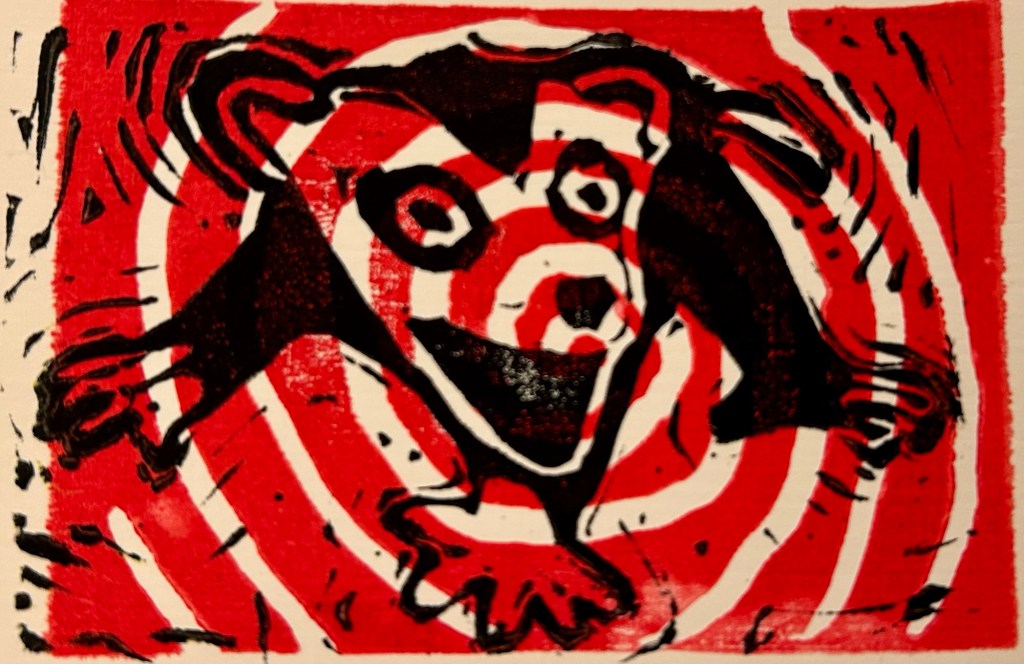
The worst (well, one of the worst) thing that can happen to you in art, or anything you care about, is to get it right the first time. When beginners luck hands you a good outcome on the first try, your impulse on subsequent attempts is to keep swinging for the fences, totally unsure how you got there, making only tiny adjustments, continually disappointed at learning nothing new.
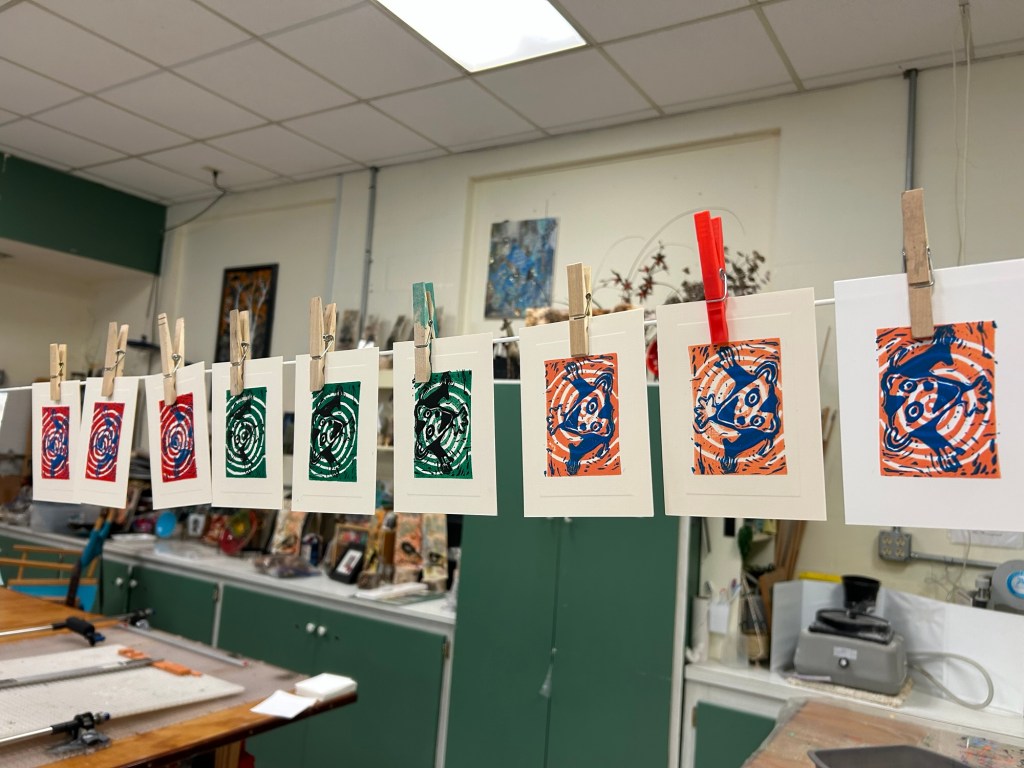
I tried linocut printmaking for the first time last week, in a one-off fun class at my neighborhood city art studio. I went in with a selfie I’d taken with a baby possum clinging to my shirt front, hoping to get something I could use as the main theme image for my website. My first attempt was successful beyond my wildest dreams.
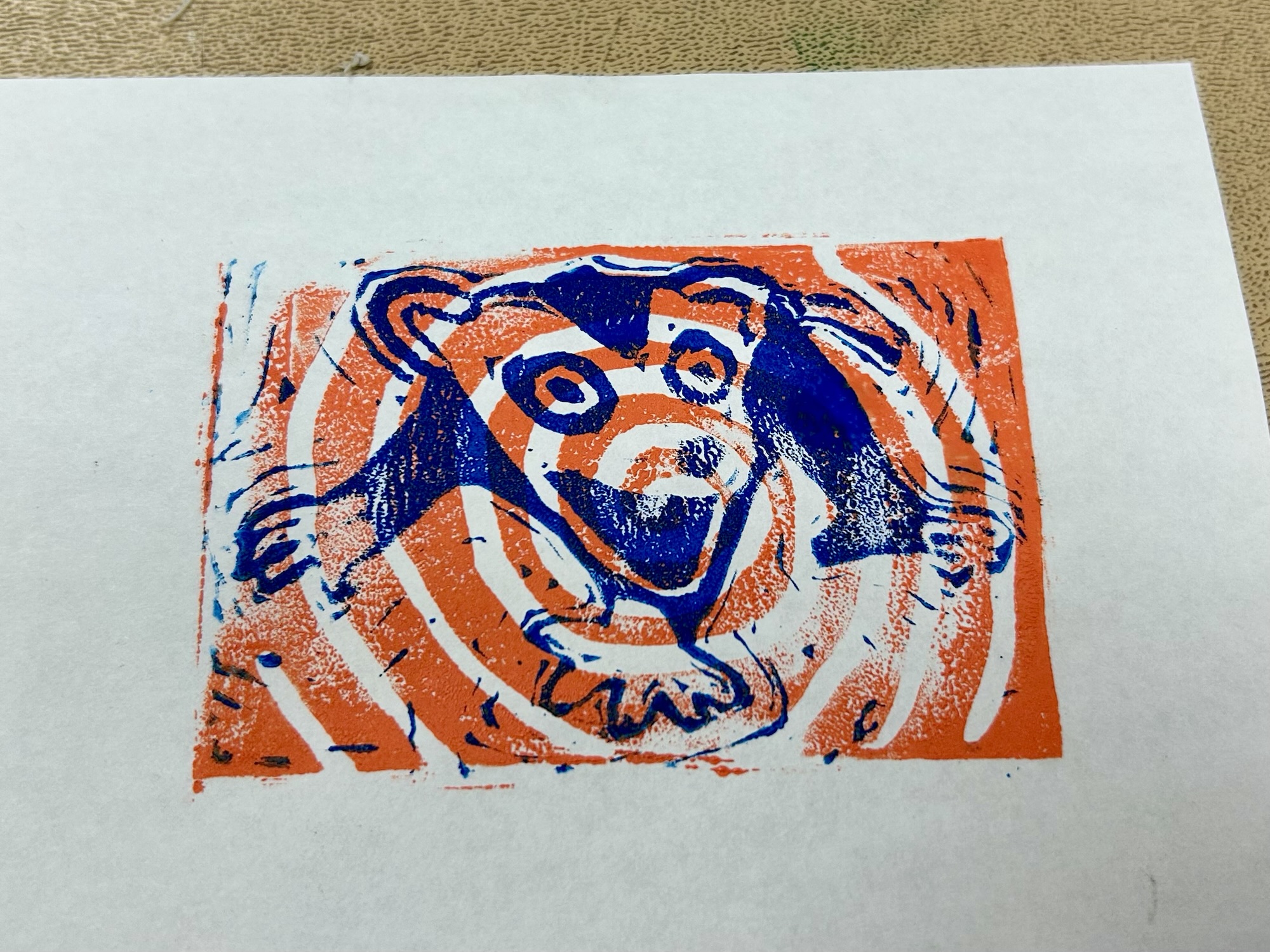
I wanted something arresting, a figure that would be instantly recognizable and relatable, but with rough, rustic elements. I had a three-hour class to do it in. I had help – C, the studio manager reduced my photocopy of the image to the dimensions I needed, and I quickly went over the important lines in pencil.
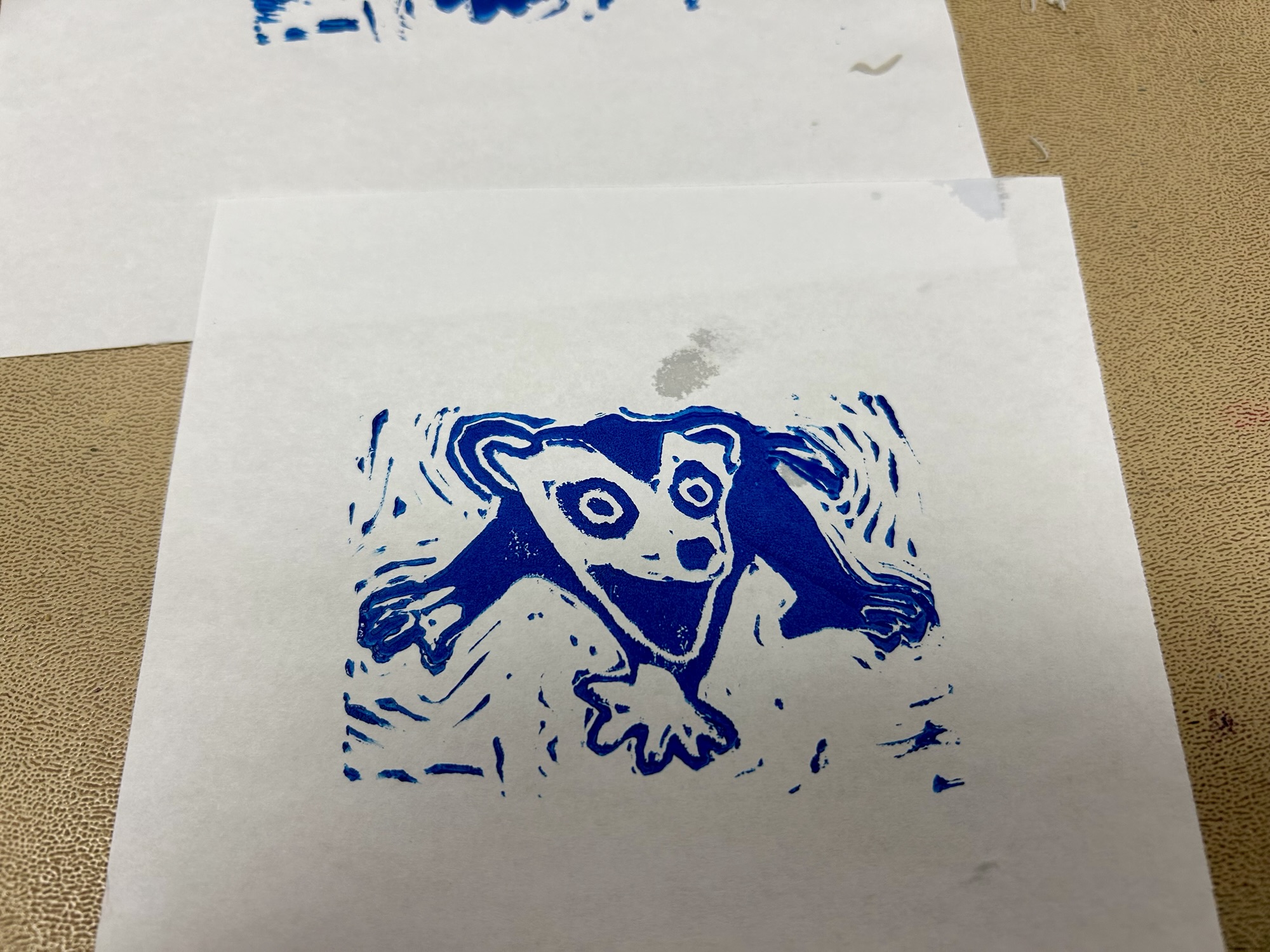
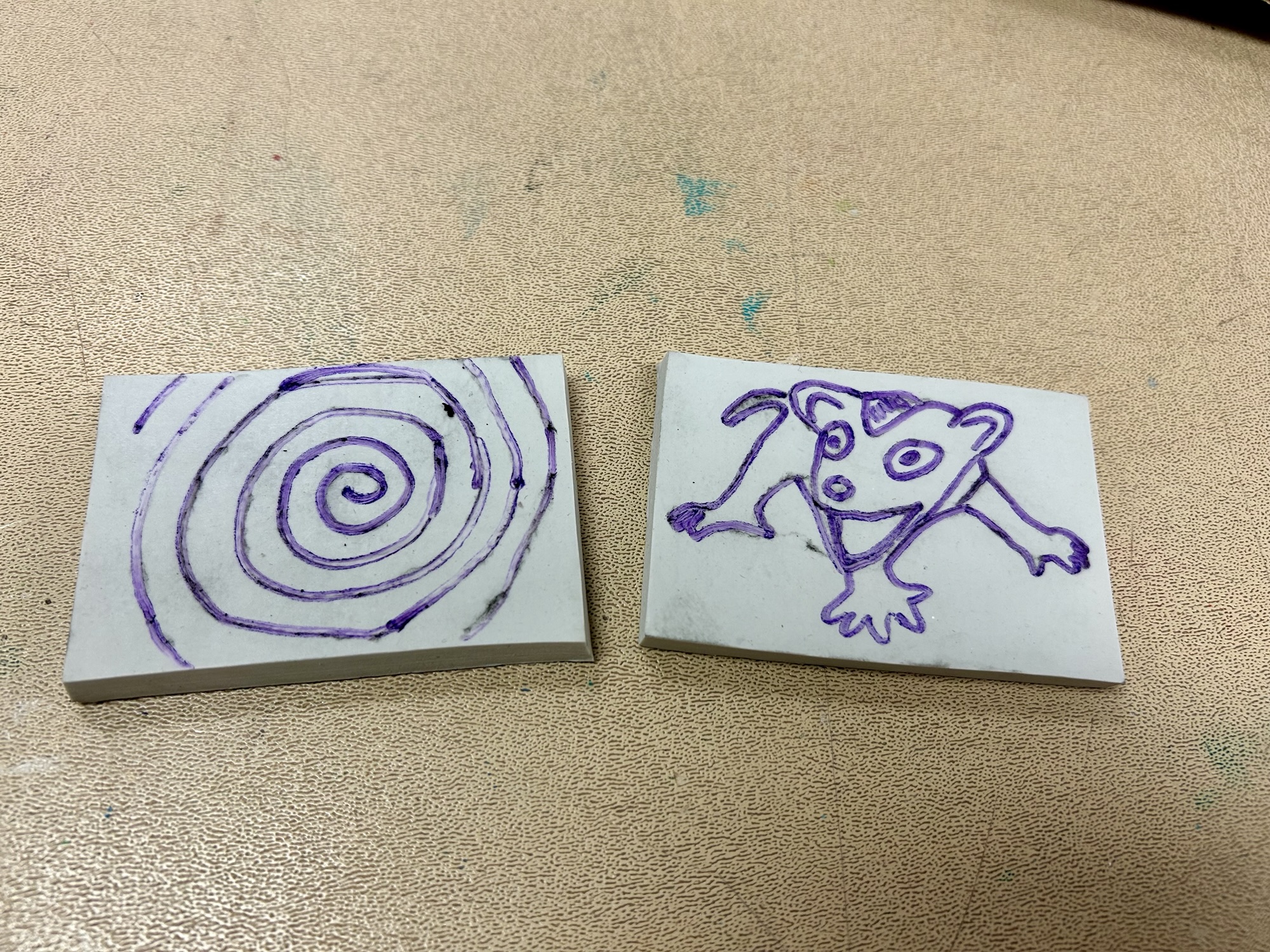
K, the instructor reminded me how to think about positive and negative space in printing. I worked quickly, looking at other people’s projects to see how they did it. In the end, I came out with at least three prints that would do pretty much what I wanted, and two lino blocks that I had, miraculously, cut just how I wanted them.
K invited me back to “club” the next week to do more printing, so I went. This was where the lessons began. Club is for people who know what they’re doing and just want to use the studio to work on longer projects. The instructors were there to answer questions, but they were also doing their own work. I wanted to see if I could remember everything I learned.
I remembered how to set up tools. The real battle was learning how much ink to put on the roller, how much to blot off the roller with a newspaper, how hard to press with the baren (a heavy, pressy-downy thingie with a low-friction surface) to transfer the ink to the paper – all the technique and muscle memory that makes the difference between your print being a solid work of consistent lines and spaces, and a patchy, blotchy mess.
When I went back to club on Tuesday, suddenly I was working without an instructor at my elbow whispering, “Take off a little more ink there,” or “Don’t press too hard.” I made a lot of patchy, blotchy messes and I was mad about it because I wasn’t doing everything perfectly in the time I had allotted myself to learn all there was to know about linocut printing.
I asked K to help me mix some colors. I know what a color wheel is and what colors are opposites, and how complementary colors combine to make other colors, but I’ve never done it. I was dabbing tiny bits of paint onto my tray and trying to mix them, but K came over and started slapping big gobs of color together. All around me I noticed people grabbing big chunks or stacks or piles of whatever tools and materials they needed. They shared everything all right, but they took as much as they needed of whatever. “This art stuff is really resource intensive,” I said to K. She laughed. “It really is.”
I kind of knew this already, but unfortunately, it’s not a situation where I’m at ease. I grew up in an environment of moral economizing, of doing as much as possible with as little as possible, and in most ways, it’s served me really well. When I barely had a job, I could still live safely because I’d learned to live on nothing. When I had a job that paid decently, I saved a lot of money from, again, living on nothing.
But you can’t learn to art with a budget of nothing. I don’t just mean money, or paint and tools. I mean time, the willingness (and time itself) to sit and stare at a blank sheet, the willingness to tear down a paragraph or a page that’s almost working, but not good enough. The willingness to write or draw or build something from beginning to end, knowing you’re going to tear huge chunks out of it before you fix it, or trash it altogether.
This is a worker mindset problem. Do your job with as little help and resources as possible. Make it work. Don’t break anything. I was raised and educated to be a worker, and a woman. Both are precarious in status. You’re supposed to make things better and easier for other people, not for yourself. It’s okay to do crafty art where you can use or eat or wear your mistakes. It’s not okay to throw away ten expensive attempts at something you can’t eat or wear, just so the eleventh one will be perfect.
But I must art, and I feel frustrated when a thing I’m working on doesn’t come out how I want, because I was afraid to break it. Smash it. Tear the guts out of it. Destroy it. And then build it again, with new and different guts. Cut the head off it and see how it walks around.
So far, I’ve thrown six entire hours at printmaking, and I am at best a talented novice printmaker. I can see the dozens and hundreds of hours and thousands of dollars I could spend getting good at this. I can also see the materials on my desk gathering dust because I can’t seem to tear myself away from doing “not art” to let myself waste “other people’s time” so I can do art.
I have the same problem with writing. When I’m writing for work (wage labor), I just sit down and words come out. They come out because I make them come out, because this is work and someone else has a demand. But when it’s my own writing, on my own time for my own purposes, I feel like I’m stealing.
I have to learn to like stealing, to believe in myself as a thief. Maybe that’s the thing – to stop trying to be good and just embrace the kind of monster I really am.
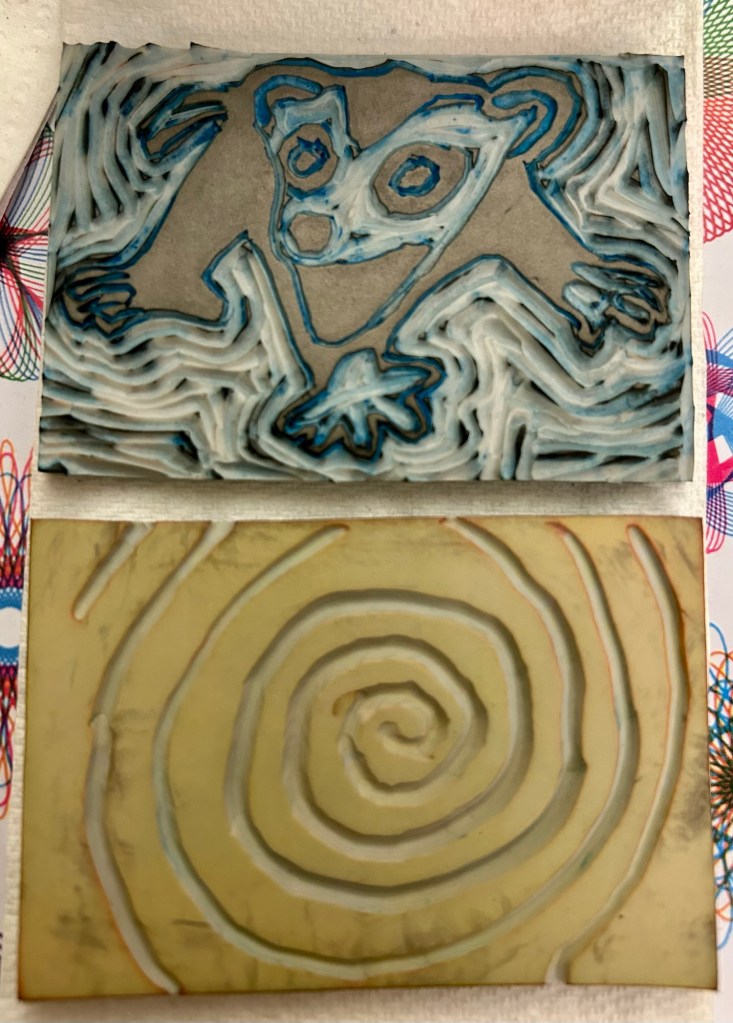
I’ll be using these prints on my website to remember important things. Nothing broken; nothing fixed
I am a monster. What are you?
 Jenna McKenna dot com
Leave a comment